
By Alon Hillel, BROKER, CCSR
A house worth $1.1 million, and not enough to run it
This fall I started working with a couple in their late seventies who own an older home in Aurora worth about $1.1 million. They’re retired, and their income no longer covers what it costs to carry the house.
Two of their adult children still live with them, and the parents still help support them. On top of that, health problems have made it hard to keep the house in good repair. It’s dated, and the renovations it needs would cost money they don’t have.
So they’re stuck on a question I hear often from longtime homeowners in York Region: sell now, in a softer market, or borrow against the house and stay? Their mortgage broker explained how a reverse mortgage works, and they’re seriously considering it before they decide anything.
Some details have been changed to protect the family’s privacy.
What is a reverse mortgage?
A reverse mortgage lets Canadian homeowners aged 55 and older borrow against part of their home’s value without selling. You keep ownership, and you don’t have to make regular mortgage payments.
The catch is that unpaid interest gets added to the loan, so the balance grows every year. The loan is repaid when you sell, move out permanently, or the last borrower passes away. Breaking the mortgage conditions can also make it due early.
The questions they asked
These are the questions I’d want answered if it were my own house. Most of them came up at this family’s kitchen table too.
Do we still own the house, and could we lose it?
You still own it. The loan is registered against the property, just like a regular mortgage, so the lender has a legal claim to what you owe. When the house is sold, whatever is left after the mortgage, other debts and selling costs belongs to you or your estate.
You don’t have to leave because you took a reverse mortgage. But you must keep property taxes and insurance paid, maintain the house and meet the lender’s residency rules. Break those conditions and the loan can come due.
The question their kids asked next: could the parents end up owing more than the house is worth? Canadian reverse mortgage lenders offer a “no negative equity” guarantee. As long as the conditions are met, the amount owed won’t exceed the home’s fair market value.
Do we have to make payments?
No regular mortgage payments are required. You can choose to make some, within the lender’s rules, which keeps the balance from growing as fast. Your usual household bills don’t go away.
How much can we get, and how do we get it?
It depends on your age, the property and the lender. Many products go up to 55% of the appraised value, and some lenders offer up to 59% for borrowers 70 and older. If an existing mortgage has to be paid off first, that comes out of the total.
You can take a lump sum, regular payments, or some now and more later. You don’t have to borrow the maximum. Taking it all upfront means paying interest on money you aren’t using yet.
What will it really cost?
The rate is generally higher than a regular mortgage, so compare actual quotes. Expect appraisal, legal and setup fees too, and get them in writing.
The bigger cost is how the balance grows. As an illustration only: borrow $300,000 at a rate between 7% and 9%, make no payments, and you’d owe roughly $420,000 to $460,000 after five years, and roughly $590,000 to $710,000 after ten. Ask your lender to run the numbers at the real rate.
Can we borrow again, or change our minds?
Don’t count on borrowing more against the house later. A reverse mortgage can restrict other borrowing, and an existing line of credit may have to be closed.
You can usually pay it off early, but you’ll repay the principal, the interest and any fees, and there may be a prepayment penalty. Ask: “If we sell next year, what would it cost to get out?”
Where their situation gets complicated
On paper, a reverse mortgage solves their cash problem. In real life, three things make the decision harder.
The house needs work they can’t do. “No mortgage payments” doesn’t remove the duty to maintain the home. Lenders can hold back part of the funds to cover repairs when a house has serious deficiencies. They could use the loan to pay for those repairs, but then they’re spending equity to fix a house that their health may not let them stay in for long.
The kids aren’t on the loan. Their adult children live there, but they aren’t borrowers. When the parents move out permanently or pass away, the loan comes due. At that point the children would need to pay it off, buy the house, or find somewhere else to live, possibly at a hard time for the family. Planning for them has to be part of the decision now, not later.
Health could decide the timeline. If the parents need to move into care in a few years, the house gets sold anyway. They’d sell with a bigger loan balance, an older house and less control over the timing. Waiting for a better market only helps if the house holds its condition while they wait.
Should they stay or sell?
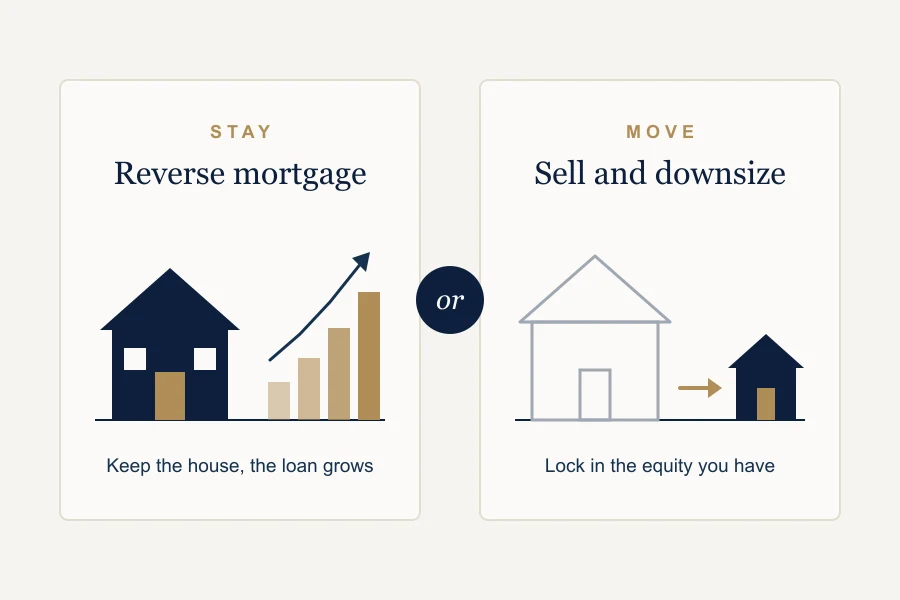
Neither choice is automatically right. Here’s how the two paths compare for a family like this one.
| Reverse mortgage and stay | Sell and downsize | |
|---|---|---|
| Cash for living costs | Yes. The loan can pay out as a lump sum, as regular payments, or some now and more later. | Yes. They live on what’s left from the sale after the mortgage, fees and moving costs. |
| Repairs and upkeep | Still their job, and a condition of the loan. The repairs get paid for out of the home’s equity. | Mostly gone. A smaller or newer home needs far less work and money to keep up. |
| Equity over time | Shrinks every year, because unpaid interest keeps getting added to the loan. | Locked in at today’s price, and theirs to spend, save or pass on. |
| Market timing | Avoids selling in a soft market now. But the house still sells one day, in whatever market there is then. | They may get less for the house, but the next home is priced in the same soft market. |
| Adult children | Can stay for now. When the loan comes due, they have to pay it off, buy the house or move out. | Need a plan for where they’ll live now, worked out together while everyone is well. |
| Control over timing | Lower. If health forces a move into care, the house sells on that schedule, with a bigger loan to repay. | Higher. They choose the moving date and the next home while they’re still able to choose. |
A soft market cuts both ways. They might get less for their house, but whatever they buy next is priced in the same market. What matters is the gap between the two prices, not the headline number.
Where they are now
They haven’t decided yet, and that’s fine. Right now we’re putting real numbers side by side: what their house would sell for as it is, what a smaller home nearby would cost, and what the broker’s reverse mortgage quote looks like in five and ten years. We’re also talking about what makes sense for their children either way.
If you want to start on the selling side yourself, our net proceeds calculator shows roughly what you’d walk away with after the real estate fee, legal fees and the mortgage payout.
My role as a real estate broker is to help with the housing side of the decision. A mortgage professional can explain the loan options, and independent financial and legal advice helps you understand what you’re signing.
For the mortgage side of this decision, a reliable source is Marcel Ghazouli, Mortgage Broker (Licence #M08005484) with Premiere Mortgage Centre Inc. (Brokerage #10317). His site, My Reverse Mortgage Canada, covers reverse mortgages in detail. For specific questions, he can be reached at (416) 455-4854 or [email protected].
If your family is facing the same choice
You don’t have to decide to move before having that conversation. Sometimes the first step is simply finding out what your options are.
Call or text us at 905-903-5455, email [email protected], or tell us where you’re at. We’ll walk through the house with you and give you a written value as it stands, at no cost and with no obligation.
Sources
- Financial Consumer Agency of Canada: Reverse mortgages
- Equitable Bank: Reverse mortgages
- My Reverse Mortgage Canada
About the author
Alon Hillel, CNE, CLHS, CCSR, is a BROKER with RE/MAX Prime Properties, Brokerage, and has been helping York Region families buy and sell since 2002. Much of his work involves helping older homeowners decide whether to stay in their home or sell. He and Kathleen Miller, REALTOR®, CCSR, founded Senior Next Move to help families with the practical side of a later-life move.
General information for Ontario, not legal, tax or financial advice. Reverse mortgage limits, rates, fees and conditions vary by lender and change over time, and the dollar figures above are an illustration only. Speak with a licensed mortgage professional and get independent legal advice before you sign anything.